Businesses in India are no longer limited to local clients. Today, freelancers, agencies, consultants, and service providers are working with clients from different countries and receiving payments in foreign currencies.
While finding international clients has become easier, many businesses still feel confused when it comes to invoicing them properly. Questions about invoice format, currency, GST, payment details, and international transfers often make the process feel complicated, especially for those sending an international invoice for the first time.
The good news is that invoicing international clients from India is not as difficult as it may seem. Once you understand the right steps and the important details to include, you can create professional invoices confidently and manage international payments more smoothly.
In this guide, you will learn how to invoice international clients from India in a simple step by step way. We will cover invoice structure, payment methods, GST basics, and common mistakes so you can handle international invoicing without confusion.
What is an International Invoice
An international invoice is a bill sent to a client located in another country for products or services provided by your business. It works similarly to a regular invoice, but it also includes additional details required for international transactions.
Unlike domestic invoices, international invoices often include:
- Foreign currency such as USD, EUR, or GBP
- International payment details
- Client country information
- Export related GST details if applicable
For example, if a business in India provides services to a client in the United States and charges in US dollars, the invoice sent to that client is considered an international invoice.
International invoices are commonly used by:
- Freelancers
- Marketing agencies
- Software companies
- Consultants
- Export businesses
A properly structured international invoice helps ensure smooth communication, accurate payments, and better record management for both businesses and clients.
Step by Step Guide to Invoice International Clients
Creating an international invoice becomes much easier when you follow a clear process. Below are the important steps you should follow to invoice international clients professionally from India.
Step 1: Add Your Business Information
Start by adding your business details at the top of the invoice. This helps your international client identify who is sending the invoice and where the payment should come from. Your business information should include:
- Business name
- Business address
- Email address and contact number
- GSTIN if applicable
If you are working as a freelancer, you can use your registered business name or your personal name based on how your business is set up. Adding complete and accurate business details makes your invoice look professional and helps avoid confusion during international payments.
Step 2: Add International Client Details
After adding your business information, include the details of your international client. This ensures the invoice is correctly addressed and makes the transaction records clearer for both parties.
Client details usually include:
- Client name or company name
- Business address
- Country name
- Contact information if available
If you are working with a company, make sure the company name and address are written correctly. This is especially important for accounting and payment processing purposes.
Including accurate client details also helps maintain proper documentation for international business transactions.
Step 3: Add Invoice Number and Invoice Date
Every international invoice should include a unique invoice number and the date on which the invoice is created. These details help you organise records and track payments more efficiently.
The invoice number should:
- Be unique for every invoice
- Follow a consistent format
- Help you identify invoices easily later
For example: INV 001, INTL 2026 001
The invoice date shows when the invoice was issued to the client. This is important for payment tracking and maintaining proper financial records.
Using a clear invoice numbering system becomes especially useful when handling multiple international clients and recurring payments.
Step 4: Mention Currency Clearly
When invoicing international clients, it is important to clearly mention the currency in which the payment should be made. This helps avoid confusion and ensures both you and your client understand the exact payment amount.
Common currencies used for international invoicing include:
- USD for United States Dollar
- EUR for Euro
- GBP for British Pound
The currency should be clearly visible on the invoice, especially near the pricing and total amount sections.
For example: USD 500, EUR 300
Using the correct currency format makes your invoice easier for international clients to understand and process.
Step 5: Add Product or Service Details
Next, clearly mention the products or services you are charging the client for. This section helps the client understand exactly what the payment is for and reduces the chances of confusion or disputes.
You should include:
- Name or description of the product or service
- Quantity or hours if applicable
- Price per unit or service cost
- Total amount for each item
For example:
- Website Design Service Quantity 1 USD 500
- Monthly SEO Service Quantity 1 USD 300
Keep the descriptions simple and specific so the client can easily understand the invoice. A clear breakdown of services also makes your invoice look more professional and organised.
Step 6: Add Payment Terms and Bank Details
International clients need clear payment instructions to process your invoice smoothly. This is why adding payment terms and bank details is very important.
Your payment section should include:
- Payment due date
- Accepted payment method
- Bank account holder name
- Bank name
- Account number
- SWIFT code if applicable
You can also mention platforms such as: Bank transfer, Wise, PayPal
Clearly mentioning payment terms helps avoid delays and ensures the client understands how and when the payment should be made.
For example, you can mention:
- Payment due within 7 days
- Payment due within 15 days
Providing complete and accurate payment information makes the invoicing process more professional and convenient for international clients.
Step 7: Include GST Information if Required
If your business is registered under GST, you may need to include GST related information on your international invoice. However, international invoicing works differently from domestic invoicing in India.
In many cases, services provided to clients outside India are treated as export of services under GST. This means you may not need to charge GST if the required export conditions are fulfilled.
Your invoice should still include important GST related details such as:
- GSTIN
- Invoice type if applicable
- GST note or export declaration if required
It is also common for businesses exporting services to mention that the supply is meant for export under LUT if applicable. Since GST rules can vary depending on the type of business and service, it is important to ensure your invoice details are accurate and properly structured.
Step 8: Review and Send the Invoice
Before sending the invoice to your international client, take a few minutes to review everything carefully. Even a small mistake in currency, payment details, or client information can create confusion or delay the payment process.
Check whether:
- Client details are correct
- Currency is properly mentioned
- Pricing and totals are accurate
- Payment details are complete
- GST information is added correctly if applicable
Once everything looks accurate, send the invoice professionally through email or your preferred communication channel. Keeping your invoices clear and error free helps build trust with international clients and improves the overall payment experience.
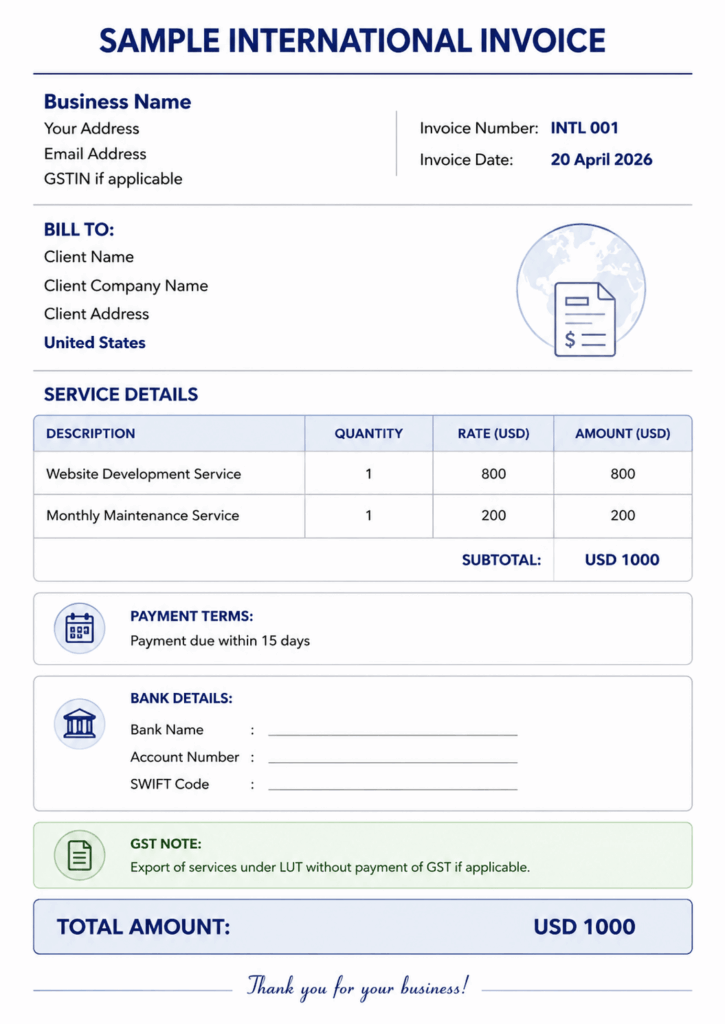
Example of an International Invoice
Here is a simple example of how an international invoice may look when sending it to a client outside India.
Common Mistakes to Avoid While Invoicing International Clients
Small mistakes in international invoices can lead to payment delays, confusion, or unnecessary back and forth with clients. Paying attention to the details can help you avoid these problems.
Some common mistakes include:
- Mentioning the wrong currency
- Adding incomplete bank or payment details
- Forgetting to include payment terms
- Using unclear service descriptions
- Missing GST related information if applicable
- Sending the invoice without reviewing totals and calculations
Keeping your invoices accurate and well organised helps create a smoother experience for both you and your international clients.
Manual vs Software Based International Invoicing
Many small businesses and freelancers initially manage international invoices manually using spreadsheets or basic templates. While this may work for a small number of clients, the process often becomes difficult to manage over time.
Manual invoicing requires you to handle everything yourself, including:
- Currency management
- Invoice tracking
- Payment follow ups
- Record organisation
- Tax calculations
As the number of international clients increases, managing invoices manually can become time consuming and more prone to errors.
Using invoicing software helps simplify this process. It allows you to create structured invoices, manage client information, organise records, and reduce manual effort. This becomes especially useful when dealing with recurring invoices and multiple international transactions.
A more organised invoicing system can help businesses save time, improve accuracy, and maintain smoother communication with international clients.
How ebilltree Helps You Manage International Invoices
Managing international invoices manually can become difficult when you are handling multiple clients, currencies, and payment records. A structured invoicing system helps simplify the entire process and keeps everything organised.
With ebilltree, you can create professional invoices using a clear and organised format. Important invoice details can be managed properly, helping reduce the chances of missing information or calculation errors.
You can also maintain client records in one place, making it easier to manage recurring invoices and track invoice history whenever needed.
Another advantage is better organisation of invoices and payment records. This helps businesses stay more efficient while handling international transactions and client communication.
As your international business grows, having a structured invoicing process can help you save time and manage invoices more smoothly.
Conclusion
Working with international clients has become more common for freelancers, agencies, consultants, and businesses in India. However, many people still find international invoicing confusing because of currency handling, payment methods, and GST related details.
The good part is that once you understand the right process, creating international invoices becomes much simpler. By following a structured approach, you can create professional invoices, avoid common mistakes, and make it easier for clients to process payments.
Including the right details such as currency, payment information, invoice number, and service breakdown helps ensure smooth communication and better record management.
As your business grows and you start managing more international clients, using a structured invoicing system can help you stay organised and reduce manual effort.
ebilltree helps businesses create and manage invoices more efficiently so international invoicing becomes easier to handle. If you want to see how it works, you can book a demo by contacting our support team.